Showing posts with label books. Show all posts

Sunday, August 15, 2010

Derrick Jensen's Endgame

Not sure this work is worth a takedown, since I am aware that Jensen is not selling himself as a scientist or anthropologist, but he is certainly selling himself as some kind of cultural soothsayer, and I think his narrative is fairly poisonous. Full disclosure: I picked this book up because I thought I’d agree with it. Sure, the title seemed a little overdramatic, and the subtitle – “The Problem of Civilization” – seemed somewhat simplistic, but overall, I’m someone who normally has plenty to say in criticism of civilization. After reading this book, I will be wary of ever 1) using the word “civilization” when what I really mean is something else, something actually evil, and 2) idealizing “uncivilized” cultures (which I’m not sure actually existed?).

When I was first introduced to Derrick Jensen's works, I was unsettled and angry, navigating my sense of the world by the unshakable feeling that something was horribly wrong with it. I had no evidence or specifics regarding this wrongness, only feeling, which is precisely the mental environment that Jensen's works do well in. Through books, mainly, the wrongness gained shape and texture, and the loneliness from being the only one to see the wrongness was relieved. This is, for the narcissistic truth-seeker, all the relief there is the world: the discovery of brethren, others who are as perceptive as you are. This is exactly the narrative that Jensen plays into with Endgame, and it's the one he seems to be trapped in. It's an adolescent narrative that might jump-start the passion needed to reform civilization, but is not at all complex or nuanced enough to come anywhere close to actually designing that reform.

This narrative wore itself out for me after a couple of years (which I spent mostly nursing that chip on my shoulder, which I'd become so attached to). Returning to Jensen's works, I gagged on the memory of all the self-righteousness, and self-loathing, in which I once wallowed. I agree with Jensen's premise that our current civilization is unsustainable, which you'd think would be all that matters, but while I agreed with this, everything else in the book left me frustrated. Which led me, as a reader, to be bizarrely caught in a position of almost trying to defend civilization, because I was so unwilling to get on board with the kind of broad, heavy-handed smears that Jensen employs in arguing against it.

Going back to the subtitle. "The Problem of Civilization." Problem, singular. Civilization is one big problem, not a series of adaptations, interactions, reactions, families, tribes, and resources. Civilization is, for Jensen, one big thing. Furthermore, all civilizations are the same. Premise 1 of Jensen's vitriolic and highly subjective series of Premises reads: "Civilization is not and can never be sustainable." He does qualify this statement with, "This is especially true for industrial civilization." It seems clear, however, that for Jensen, civilization is industrial civilization. Many of his complaints throughout the book are targeted toward the exploitation of resources characteristic of industrializing: building dams, leveling forests, using sonar to conduct military exercises, raising livestock in factories. On and on. All of which, to be clear, I am absolutely against and agree are entirely unsustainable activities. But not all civilizations, obviously, engage in this kind of exploitation.

Jensen does spend a couple of pages attempting to define what civilization is. According to himself, civilization is “a culture...that both leads to and emerges from the growth of cities, which cities being defined...as people living more or less permanently in one place in densities high enough to require the routine importation of food and other necessities of life” (17). Though the distinction is interesting, I cannot accept this as a useful definition of civilization. The importation of food seems to be, rather, a beginning criteria for industrialization. As Jensen himself points out, civilization also includes political, artistic and social activity, as well as economic activity; many “non-civilized” nations had basic bartering or gift economies (which, again, Jensen isn’t ignorant of since he points it out himself). He fails to heed his own distinctions here, however, and instead lumps all human dynamics into the paradigm of civilization. For example: power, which according to Jensen is “civilization’s other face” – tell me, what human society, civilized or no, does not function on some kind of power dynamic? Or division of labor, which Jensen brings up a sentence or so later. Again, same point: what hunter-gatherer or other “non-civilized” society did or does not function through division of labor? These dynamics are necessary to the behavior that has evolved with our species, and that we need to survive. Sadly, Jensen doesn’t like science, so evolutionary biology is totally ignored, not even given lip service, but I’ll get into that later.

Without a useful set of criteria with which to define civilization, and without fully acknowledging the complexity involved in creating and identifying one, Jensen ploughs angrily ahead. Dude is pissed, and I think that anyone with an environmentalist streak at one point feels the sheer frustration of knowing that all the processes which have kept us alive are so incredibly destructive. However, how much you are willing to identify yourself as one of the destroyers is key to the creation of your own narrative. Jensen more than once acknowledges that he is a human, and thus uses cars and airplanes to get around, shops at a supermarket, etc etc. But there is a total disconnect between this acknowledgment, which is easy enough to make without being totally serious, and the strategies he briefly sketches to get everyone off civilization, the most prominent of which is his idea of taking down cellphone towers. Cellphone towers, which kill thousands of birds every year, seem like a pretty obvious thing to want to destroy: they’re ugly, they seem sort of decadent, meaning something that we could probably live without. Also, they’re often disguised as palm trees, so you’ve got that factor of deceit and denial that is so specially infuriating. So take down the cellphone tower, Jensen, and maybe Ed Norton will play you in a flick. But if you keep going in this direction, what are you going to take down next? The gas station, which is key to your ability to get around? The grocery store, which supplies most of your food?

I’m pretty sure that Jensen would respond that he’d adapt, that he’d be fine not writing books and taking book tours, and would learn to farm. But people just aren’t ready to do this, and expecting to “take down” civilization, I’ve become convinced after reading this book, is incredibly impractical and naïve. Narratives only go forward, not backward, and the same with evolution. We have evolved to live in civilization, for better or for worse, and unfortunately, even if we were to “go back” to a time when we understood our impact on the environment, that process would involve an evolution of what already exists. Which is why I am personally in favor of sustainable development, of which Jensen is certainly not a fan.

But going deeper, this does indeed point to some key psychological issues. Though Jensen’s points about living in civilization being like living through an abusive relationship, where civilization is the abuser, are pretty much incoherent (I appreciate this as a creative idea, but certainly not anything to base policy or large-scale action on), he is right to probe the psychology of the current human living in civilization. All the problems that Jensen is battling in this book are a result of an unclear definition of the human species. What is a human? Are we moral creatures, and if so, what is our morality based on? Jensen’s implicit argument is that we consider ourselves morally responsible only to our own species, which is mostly true, I’d have to say. And the question of how we shift our morality to include other species (as indigenous, “pre-civilized” cultures did) is, I believe, the most interesting question of our time. For some reason, it’s obvious to some that exploiting animals is wrong, and yet for others, it’s obvious that we should dominate animals in every way because we’re “smarter” than them.

Again, Jensen acknowledges the intellectual rationale for this—that morality in this world is relative—but doesn’t really heed this sensible acknowledgment, and doesn’t let its implications reverberate over his entire book. If morality is relative, it’s moldable, changeable. This seems like a really hopeful thing to me, but how does one change morality? How does one make the case that exploiting non-humans is morally wrong? Answering this question requires stepping back and looking at this idea in the first place: why should we want to convince people that exploiting non-humans is morally wrong? Because if they die, we die. Jensen expresses this as the idea of the “landbase,” whose health has to be the focus of all human activity in order for the society to survive. This is absolutely the case, but Jensen fails to make this connection explicit: we need to view non-humans and the landbase not as moral ends in themselves, but because they represent our survival. It’s a shame that Jensen’s book is so incredibly disorganized, because I’m sure this is what his thinking is, but it just isn’t clear. Instead, the moral reasoning that comes through is that civilized humans don’t value their landbase because they are evil, and that is why we should take down civilization.

The other question, about what a human actually is, is obviously one that should be an ongoing discussion. On page 235, Jensen responds to critics (imaginary? I don’t know) who argue that “humans are natural, therefore everything they create is natural.” This gets into a sort of semantic game, as Jensen calls bullshit on this and says that polluted streams and asphalts are “unnatural,” which, okay, in a certain limited sense they may be, but I believe this semantic problem gets at the heart of the issue here. If we are essentially “unnatural,” because we are surrounded by unnatural things that we created ourselves, the narrative is that we have become evil. This has a lot to do with the more everyday self-loathing that comes with thinking that civilization is wrong: on some level, you know it’s you, and the only appropriate response is to get angry.

If Jensen weren’t so dead set against science (which he seems to view only as an institution, not as an activity), he would recognize that evolution hasn’t suddenly transformed us into evil beings, because in nature, there is no evil. There is no natural or unnatural. The word “unnatural” should be taken completely out of the discussion. It creates an unnecessary split, between the supposedly perfect, earth-loving cultures that existed hundreds of years ago, and the ones that exist today. Think about it: birds evolved body parts and brains to be able to pick bugs out of trees and the ground; cats evolved to spot and chase small rodents; whales developed brains that can detect and communicate with undersea vibrations; and humans have likewise evolved to cogitate, to reflect, to have ideas, to use tools and build things. There is nothing we are doing that nature didn't equip us to do. The question that evolution cares about isn't whether a species is evil; it's whether they are successful. Plenty of species have failed; we might be the next one, and evolution would go right on. If there is a case to be made (which of course, there is), it isn’t that we need to take down civilization because it, and we, are evil; it’s that we need to harness those powers that evolution has given us to make our civilization sustainable.

Saturday, June 5, 2010

the modern dream of authenticity

just went for a run and got totally soaked.

I reviewed Remainder because it kicks ass. it's not quite like anything else I've read. it has no real interest in some of the staples of storytelling - characterization or human relationships. the reason it works as a novel is because of its extreme attention to plot, which is, as Tom McCarthy knows, nothing more than a pattern. this book is very concerned with patterns. mostly, it is about space, and authenticity. the latter idea is the one which connects the whole enterprise to the tradition of philosophy, in my mind.

McCarthy isn't usually a novelist; he runs a theoretical group called the International Necronautical Society, which ostensibly has something to do with death and space, or death as a space, more specifically. this comes up in Remainder, although the novel isn't about death, I don't think (I might change my mind after a re-read). at least on the surface, it's more about that authenticity theme, which is explored through the use of re-enactments and re-creations of scenes.

I'm not sure exactly how McCarthy came upon the idea of writing a novel; I think he's probably trying to promote his theoretical group, which is half-fictional by his own description, in every form and medium possible, and had just come around to the novel form. I really like this idea: creating a philosophy (however much it is really original or just a response to older philosophies) and then distributing it through every form of media available. however, I also like to think that novels are the perfect form for exploring ideas, and that story is a privileged form of information that can be used for the communication of highly complex thought. I have seen this done in a number of ways - Blanchot, one of McCarthy's heroes, writes these distended riffs where nothing at all happens except subtle shifts of philosophy - and I feel like McCarthy's example was one of the more successful. at no point did the drama overwhelm the ideas of the novel, and yet it was still a page-turner. I think there's a lot to be said for the thriller form, which Paul Auster used to his advantage in City of Glass. in fact, a lot of points in Remainder seemed directly related to the moments with the man wandering around the city in Auster's work: that obsession with space, the conviction that it will reveal something essential and transcendent.

this is a video of the INS' Manifesto on Inauthenticity, delivered at the Tate museum in London. I love this video. it seems to be the best outlet for INS, in my opinion; especially if you do a little research and figure out that the man speaking is not actually Tom McCarthy, but an actor. I also think this manifesto gets closest at the themes Remainder is about.

the half-fictional aspect is the other thing I find really fascinating. there are some moments where the Manifesto is clearly imitating staid academic prose and absurd overwrought theory (there's a pretty banal analysis of Queequeg, although I'm actually not certain of how serious McCarthy was about that bit), but then ten seconds later one of the speakers will come out with a really fascinating idea. I love the idea of tragedy being a reconciliation of inauthenticy and authenticity - the recognition of the inevitability of cause and necessity on one hand, and the free acceptance of that on the other.

the awesome part is that it seems to rely on me to determine whether any of it is serious or not; I might find one part insightful and fascinating, but someone else might think that's part of a joke. by making his movement "half-fictional", McCarthy puts the onus on us.

Sunday, August 23, 2009

GIVERS AND RECEIVERS

I was home recently, and had access to books that I normally associate with my childhood (which for some reason had gotten shoved into an obscure corner of the closet). I have been rereading important books in my life with the purpose of evaluating them in light of the project I'm working on, and it seemed totally obvious that I should start with the giver. this book sort of defined the second half of elementary school for me, reading-wise. because I was so young I didn't go all crazy researching lois lowry and reading interviews with her, as I would have now; but the story itself remains just as sharp in memory as it did when I first read it. in fact, now that I know a hell of a lot more than I did in fifth grade (thank god), I can now properly identify this story as a Myth with a capital M, something that is emblematic of some essential part of the human experience.

even in fifth grade I immediately knew after reading it that this book was something totally different from anything I'd read. my relationship with the characters and the story-world was natural and total. also, like any good myth, though you can't exactly see everything that's going to happen ahead of time, when it does happen you realize it's exactly what you expected. there's some kind of weird paradoxical relationship where a myth exists outside you - it's already there, you're living it, and yet it's only after you read the book that you knew you were living it. this book was some kind of knowledge I had never felt before and didn't know the name of, yet.

so now I took it up again and was just stunned at how fucking dead-on every single note is; every point that lowry should have hit is in there. I mean every single one. I was a little afraid that the story would seem trivial and cloying, since it's a kid's book; but honestly, I don't see why this couldn't be read by adults. the themes of it are just so huge and deftly handled. there's the idea of a controlled society, the cartoonish transformation of the world we know into something calm and absurdly soothing and predictable. this isn't so unique; it's in a lot of speculative fiction (wrinkle in time comes to mind). but then add this dynamic of the student and teacher, both absorbing and exposed to a kind of knowledge that the rest of society can't handle. jonas and the giver are basically shamans (shamen?), individuals who experience breaks from society and have to grapple with a depth of knowledge that most people don't.

so there's that. then there's the idea of the knowledge itself: the "seeing beyond" as lowry puts it, that's the cornerstone of like all metaphysics and, you could argue, all philosophy. the way she puts this in the book is just fucking beautiful. I realized as I read it that I had ripped it off recently, after not reading the book for at least ten years. that's how deeply this book was able to probe into me. jonas' particular special aptitude is seeing color; he sees an apple turn red, and then takes it home, trying to "make the thing happen again." the language is basic; there is really no clutter or wasted space in this book at all.

added to that, or rather working necessarily with all the stuff I just mentioned, is the idea of everyone in society having a "function"; this also reflects older societies, though I doubt they were so precise (or maybe their precision was a different kind); and of course the initiation represented by the "ceremonies" where they turn one year older, comes directly from older societies where youths are put through "rite of passage" ceremonies.

I mean, these are some extremely deep, extremely essential human ideas and archetypes that lowry's dealing with here, and her pacing and control of story is just dead fucking on. I just could not believe, on reading it again after so many years, how much she just nailed it.

I can't help but think also that it wouldn't be so successful if it weren't a book meant for young adults. really, the ideas (as I said) are adult-level, but the fact that it's a YA book means she's able to stick with a very simple language style, which is probably the way myths were told ages ago.

so it seems like everything just fell into place for a perfect book. and it finally occurred to me to research lois lowry and how she could possibly do something so perfect, and either I'm not finding the right interviews or she sort of did it on accident. this is what she says about how she thought of the book (from here):

My brother and I had prepared a photograph album filled with images to spark his memory. In 1956, he had had a green Chrysler that he loved. When he saw a picture of it, his eyes would always light up. That day, he came upon a picture of two little girls, and he said, “There you are with your sister. I can’t remember her name.” I told him her name was Helen. He looked a little puzzled, a little confused, and asked, “What ever happened to her?” I had to tell him that she had died; for him it was as if her death had just occurred. I turned the pages to show a house we had lived in, a dog that we had had. But within five minutes, there was another picture of the two daughters. He lit up again and said, “Oh, there you are with Helen. I can’t remember what happened to her.”

Driving back to the airport that day, I began to think about memory—how we use it, how painful it can be, yet how necessary. What if we could manipulate it? What if I could leave my mother with all those happy memories of puppies and picnics and take away the sad memory of the day her daughter died?

I began to play with the idea of people who had learned to manipulate memory. I realized such a story would have to be set in the future. I began creating a community quite different from the ones we now have. I never thought of the book as a science-fiction novel or that I might need to explain its technology. I still get letters from readers, usually boys, asking for specific details of how the weather was controlled or color removed from objects. But I didn’t feel a need to put technology in the book. Nor would I have known how to figure it out!


so, okay, I understand that ms. lowry, but then how did you hit on the idea of the transfer of knowledge through one shaman to the next generation? how did you position your story so that it touched on so many hallmarks of human nature - the rite of passage, the compartmentalized organization of society, the "ability to see beyond"? how the hell did you get all that just from thinking about your grandparents losing memories? I mean, part of that quoted paragraph sounds like the ideas that kaufman probably thought about when he created eternal sunshine - i.e., what if you could erase bad memories. when I think about this, it seems to me that she just created a myth by accident, which is so flabbergasting to me it's almost beyond belief.

I mean, there's a huge gap in my knowledge of her creative process, here. the problem is that the interviews and articles all treat this book like a kid's book; she's answering in the same simplified language that she writes in, which is only natural. but this book is complex enough to be discussed in adult language. there's a ton of potential room here for study on a high level, incorporating study of myth and narratology. I could write a dissertation on the complexities of this "novel for young adults".

which leads me to think that there are books, and then there are myths that happen to be books. the giver is one of the latter. when you read some of the criticisms of it - that "everything happens a certain way because it's supposed to happen that way", a common criticism that I have made myself of stories that seem too easily resolved - it's clear that the writer of those remarks is thinking on the level of book, and not myth, where events are necessarily meant to represent the course of an idea, and have to be anything but arbitrary.

as for this book's power to impart knowledge, I will just cite (from the same interview) the example of one reader:

Another boy came up to me at a recent book signing. He had just graduated from high school, and he gave me a letter and asked me to read it later. In this note, he told me that he went to a private school, and in senior year each student had to speak to the entire school at an assembly. When his turn came, he went up on the stage and said that he learned more from reading one book than anything else that had happened at school. It affected him more than any class he had taken or any lecture he had heard. Consequently, he wanted to share that book with the assembly. He began to read The Giver aloud; the 30 minutes for his speech time came and went. But then he said, “I am going to read this whole book; you can come and go as you want.” Many got up and left, and some stayed, and some came back. Over the course of the next several hours, he read the complete text of The Giver.


goes without saying that I agree and sympathize with this. the giver taught me way more than I realized, until reading it again. it's part of my DNA, at this point; has helped to make me aware of how we control our own societies, how we are alienating ourselves from nature (the animals in the giver are all "elsewhere", no one has ever seen them), and perhaps most importantly has given me an extremely potent metaphor for "seeing beyond" and the vocation that this can bring about. virtually every cornerstone of my own personal ethos, the principles that I consider most important, can be felt in this book. and yet I'm sure the book didn't create those sensibilities in me; it just greatly, greatly helped them emerge.

lois lowry is in her seventies and I don't know if I'll ever get a chance to correspond with her, but I sometimes wonder if she really understands just how important of a story she created with this book. perhaps her creative process was necessarily obscure to herself - if she had gone in consciously trying to create an Important Story, she might have failed miserably. instead, it seems like she just had an extremely acute instinct for story elements that hold great meaning.

Sunday, May 24, 2009

I TOOK THIS CLASS IN COLLEGE ABOUT ISOLATED CHARCTERS IN LITERATURE, IT WAS VERY BAD FOR MY SOCIAL LIFE

after school ended all my thoughts fell apart and hid themselves in strategic spots around my apartment. I'm not trying that hard to pick them up. it's like I want summer to be a break from being whatever I was during the year; I want to try being a jock or a dancer or someone that has never cared about literature or language or archetypes or the brain. like how it'd be easier to appreciate life if you could just know what it was like to be dead for a little bit. (see below..)

having a contest in my head for which adolescent-angst story will best stand the test of time; I have a whole collection of these queued up in my brain as though I had lived them, as though they're my own memories and I lived multiple lives in these multiple stories. I will never hesitate to admit that I fucking love me some quality adolescent angst, and the term "coming-of-age story" makes me salivate.

so now, it's time for considerations and comparisons. I'm taking out of the running stories which didn't make me feel the angst; stories like this side of paradise, in which amory is so obviously playing at being confused that it doesn't hold as a tension device; and the brief wondrous life of oscar wao, where the angst feels kind of second-hand and indirect and, more often than not, comical.

I suppose you can't really start a discussion of this without first naming catcher in the rye; I don't really see how you can beat this book for sheer character, voice, and these stealthy nods to coming-of-age archetypes, like when holden can't cross the street because he's afraid he'll fall before he gets to the other side. there are a couple of funny things about catcher: one, the parents don't seem all that bad, they seem pretty normal. they show up hardly at all. I think this is what led to a lot of my peers in high school sort of hating this book for being "whiny" or something.

the other odd thing is that holden doesn't change much through the course of the book; there's not a whole lot of difference between the holden at the beginning of the story and the one who's supposedly telling it from an institution or whatever. the book ends with the defeated line, "don't ever tell anyone anything, you'll start missing everyone," which sort of indicates that maybe holden has recognized a little that he mistreated people and should've appreciated them, but it's not much as far as character change goes.

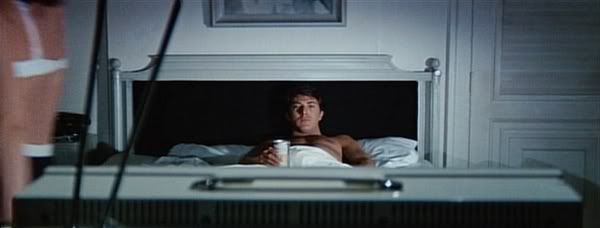
harold and maude goes in the opposite direction (or as opposite as you can go for stories that feel like they take place in the same universe), and you see a very deliberate "character arc" being carved out: basically, harold learns to appreciate being alive. (seriously, boil this film down to its basic components and it seems scoff-worthy.) the harold who in the beginning feigns his own death a dozen different ways (and seems to possess no natural, human facial expressions) is very different from the character who's blowing bubbles in maude's bed.

the other 180-degree turn it takes from catcher is the total mockery of the parental and societal figures in the world; harold's mom and uncle are so ridiculous this movie almost verges into camp. I sort of resent the maker of the film for making it so easy to hate everyone around harold except maude, and yet it works because in many parts it is incredibly funny. the other reason it works, of course, is because it's balanced out with maude's very genuine carpe-diem spirit and love for the world; there's plenty of genuine feeling in this film. that moment where they flash to maude's holocaust-camp tattoo and then, barely showing it for a second, to maude pointing out how beautiful the sky is, may or may not strike you as cloying, but it's likely that you're so far on harold's side that you'll go along with it.

all of these characters have therapists. in fact, donnie darko might be harold and maude if you replace the carpe-diem message with deux-ex-machina. they both have disturbing visions; they see therapists for this reason. in these scenes, the therapist is not an entirely evil character. donnie's therapist even becomes a borderline appealing character, although she clearly is not cool enough to laugh or go along with it when donnie, under hypnosis, puts his hand down his pants. harold's therapist seems stupid but well-meaning. in both cases, and this is a key thing, I think, with these coming-of-age stories, the patient does not entirely resist the idea of being helped, of opening up, with the irrepressible hope that maybe, despite how uncool and idiotic these suit-and-tie characters are, they might offer some kind of wisdom.

which reminds me of every scene ever written by david foster wallace with a therapist in it. I sort of think that parts of infinite jest could be considered a coming-of-age novel on their own; certainly, hal was what I focused on the first time I read the book. the scene in the beginning, where hal's dad is pretending to be a therapist, simply reeks of the exact same pathos that permeates the aforementioned films. the therapist is almost a confidant, yet never manages to quite shed the external signs that s/he is part of the whole stupid mess that made this young person feel alienated in the first place. of course, when DFW tackles this emotional paradox he adds another layer of consciousness that you can't quite get in a film, where a character would freak out for about a page about using such a pretentious term as "alienated."

the graduate has a character reaching this same point of absolute alienation a few years later than harold and holden did; the narrative thus deals with situations that are a little more adult than the other films (although I guess it's true that harold dates a woman MUCH older than mrs. robinson). but this film is harold and maude, it's donnie darko, it's catcher in the rye. the way I can tell this is that the gaze is exactly the same in all three films: I mean, this is basically this is basically this. (harold and maude and the graduate actually have a lot of shots that recall each other; maybe because they were both shot in california?)

and guess what - all these stories are centered around male protagonists! which means that the catalyst is always a love interest, always a girl. (perhaps this is why holden doesn't quite complete that character arc - his love interest never pans out.) but what about the girl?

it's been, admittedly, years since I read the bell jar; I'm not sure why it's made less of an impression on me, maybe because it seems to lack the humor that the other stories have about themselves. I don't think we ever had to read it for school. I'm not quite sure what the female model of the coming-of-age story is; I don't have enough personal examples. I think it might be something like amelie, which I would count in this group. it's also the only european work I've considered here.

so there is this type of coming-of-age story that is american and male, and I'm sure I'm not the first person to have noticed that. I think it's interesting that these stories always remain very pro-individual; the character arc is never joining with society, realizing one's adulthood by finding a useful role in it. it's always "finding oneself" and society be damned. what happens to these characters right after their story ends - donnie's dead, harold is wandering around playing a banjo having just destroyed a car, and the famous example of benjamin and his stolen bride sitting there awkwardly in the back of the bus with more than a hint of anxiety in their faces - is probably not nearly as triumphant as what came before. I think it would be quite an achievement if we had a) stories that centered around females and b) stories that weren't so defiantly pro-individual throughout, but showed the character learning how to appreciate other people.

Sunday, March 1, 2009

THE PALE KING

I just slept eleven hours and then gorged myself on all the new DFW-related material on the New Yorker website. reading posthumous stuff is becoming a routine experience, one I know well enough to distinguish the various stages - a burst of excitement, and then subsequent melancholy on realizing that there won't be new material forever. I mean, there won't be anything forever, but there is always that weird brush with infinity after reading something posthumous. you do get the sensation on reading a new piece that DFW has once again gotten completely outside of himself and what's already been written. it's the same thing as hearing a new Radiohead album - you just think, this person can do anything. I can think of a few artists who just recreate the last thing they did, and it's like The Last Thing I Did 2.0.

what I am amazed by anew is DFW's total mysteriousness about what he was working on - you don't realize how many gaps there are in your knowledge until you read an article like this one, which stitches together his life and fills in a bunch of holes. like, he made a comment in some article about taking an accounting class way back in the late nineties or something, but that's almost all he said about it. there were bits and pieces for years, but their subjects were so diverse - that one about the kid who has to put his lips on every part of his body (I love this one), the "evil child" piece in Harper's, and "Good People" in the New Yorker, which I was astounded to find out was part of this larger work - that I really didn't think there was any single project being worked on. I think the speculation in the DFW community was that it would involve a series of portraits of children (which may have been another project in the works, but not the big one). turns out he was just really really good at keeping quiet about that stuff.

anyway. this is the most important part, the excerpt from the novel, The Pale King. I'm going to be reading it many times over the next few weeks, but I'm struck, on a superficial level, by the lack of quotation marks and how the dialogue is just streamlined with the rest of the text - just another one of those things that seems so intuitively right and simple and makes me wonder why the hell I didn't think of it - and, though this echoes Gately in IJ, the discrepancy between the hyper-verbal interior state of the ghost versus the relatively pedestrian comprehension of the protagonist (when he hears a word he doesn't know DFW writes him as inventing a string of simple words that it sounds like to him, like "bone after tea").

the deeper and more far-reaching things about boredom, its difficulties and possibilities as the subject of a novel, I probably won't be able to comment on until I read the whole thing (which I have no doubt will come out in some form), but I will reiterate my astonishment that DFW seemed to reinvent himself with every work, and not only on a stylistic level but in his philosophy of life and writing. I am as obsessed with his career arc as I am with the writing itself.

Tuesday, January 27, 2009

THE FUTURE IS FULLY OPPOSABLE

what is going on? what isn't going on? I have had my head in many different doors lately. not quite a presence yet, but approaching. next week I have to present on ben marcus and I am looking forward to it so much I might start working on it right now. I remember visiting UIUC and the head of the program (who was a really nice guy, definitely the best thing about that school) talking to me about wire and string as being "a manual for things found in dreams," he said, and I'm totally stealing that idea.

I feel that I am getting further into something - my own head, or my own body, I'm not sure which.

been reading EVER by blake butler and listening to a lot lot lot of subtle. exiting arm is fucking amazing. it is an album with a premise: a character named 'hour hero yes' falls through a door into a world where he has to create pop songs, and he decides the only way he can do it is to write subversive hidden things in the lyrics. oh man, that would be awesome enough as a commentary on the 'industry' and the position of artists, but it really works with this album. if you listen to it as just a collection of rock/pop songs, it might sound a little bit off, like they're just not quite sure how to write one. I saw subtle a year or so ago and had no idea what they were trying to do; I was mostly there to hear dose one (which was totally worth it in itself, guy raps faster than the speed of light). I feel better oriented to understand these albums now, and they amaze me. perhaps the best combination of spoken word and melody I've heard, besides alopecia by why? which I listened to nonstop over break and think is fantastic. why? does appear on some of subtle's albums, he is part of that same group based in oakland which once put out maybe the BEST lyrics-based experimental album ever, cLOUDDEAD.

fuck, I could just go on all day about these dose-one projects.


tomorrow I am going to see deb olin unferth. what the hell should I ask her?

Wednesday, January 7, 2009

THE LONELINESS OF SENTENCES

Once the words begin to settle into their circumstance in a sentence and decide to make the most of their predicament, they look around and take notice of their neighbors. They seek out affinities, they adapt to each other, they begin to make adjustments in their appearance to try to blend in with each other better and enhance any resemblance. Pretty soon in the writer’s eyes the words in the sentence are all vibrating and destabilizing themselves: no longer solid and immutable, they start to flutter this way and that in playful receptivity, taking into themselves parts of neighboring words, or shedding parts of themselves into the gutter of the page or screen; and in this process of intimate mutation and transformation, the words swap alphabetary vitals and viscera, tiny bits and dabs of their languagey inner and outer natures; the words intermingle and blend and smear and recompose themselves. They begin to take on a similar typographical physique. The phrasing now feels literally all of a piece. The lonely space of the sentence feels colonized. There’s a sumptuousness, a roundedness, a dimensionality to what has emerged. The sentence feels filled in from end to end; there are no vacant segments along its length, no pockets of unperforming or underperforming verbal matter. The words of the sentence have in fact formed a united community.

I have never heard anyone describe sentences in quite this way, making them bigger and bigger until it seems like they are all that's important in literature. which of course is true in a way, because in writing you have nothing but sentences. sometimes there are weird shapes behind the sentences, but as lutz is saying here, you can't get those shapes unless you have chosen exactly the right words for your sentence; you have to find the only words that could possibly work, and then you will have communicated the right shape or concept to the reader. at least, that is my interpretation of this article, which is fantastic.


yesterday I went to a bookstore I am fond of and had an interesting experience. I just went around the store and spent a lot of time looking at specific books, ones that I had read about and knew the names of the authors, which seemed to be a lot; I think this was because I am used to going to corporate bookstores and they have like nothing of what I'm looking for. as I went around looking at these books I had a weird feeling that I was having conversations with them, I do not mean I went around the store saying things out loud, but there are some times when your interior voice becomes very articulate and it was happening in the bookstore. I picked up one book written by an ex-drug addict and the blurb said something like "this book is full of fucking heart and will be remembered when the zadie smiths of the world are forgotten" and I said in my head to the book that's not fair, you can't compare things like that, what zadie smith and others are doing is sure more intellectual or concerned with aesthetics than the stories of an ex-drug addict, but that doesn't mean one is more worthy of people's time. I found a book by lydia davis in which she had written this little part about how this character felt like an old man most of the time and this made it difficult to be a young woman and when young men flirted with her she would think, why is this young man flirting with an old man? and the conversation in my head went something like, lydia davis, you don't understand, I fucking love you.

so I decided that, if I am ever at a point in my life that I am just without a plan and wanting to move somewhere anywhere, I will choose any place that has a good independent bookstore. I feel that good things will happen in a town with a good independent bookstore.