if you grew up with my generation, you know who the Dude is. I learned this in college, when I saw lebowski for the first time. after the film, jeff bridges came out in a bathrobe, slouched on a chair, and rambled a bit about filming the movie. jeff bridges, imdb tells me, has had trouble with pot in the past. imdb also tells me the Dude wears clothes that belong to jeff bridges. one other time, at my shitty job in a smoothie place that I worked for a short while, jeff bridges came in - or was it the Dude? he was wearing shaggy hair and a tie-dye shirt. it seemed like something to get really happy about. as the Stranger says, it feels good to know the Dude's out there, taking it easy for the rest of us.
I think about these things when I watch lebowski, which I have done countless times in the past few months. someone in high school told me he smoked pot because he "thought faster than other people" and pot helped "slow him down." the big lebowski is better than pot. it is reliable as anti-anxiety medication. it will not kill your brain. it returns to its themes and characters like an obsessive. for a movie about a slacker, it's incredibly tight. there are moments that I still have not fully embodied, corners of the lebowski universe whose meaning is still cryptic to me, though of course by now I know the plot. somehow lebowski achieves a blend of plot and setting and most of all character that cannot be deconstructed. take any of them away - take away Jesus the pedophile, take away the dream-sequences, hell, take away even one bowling pin and the movie wouldn't be the same. everything's lined up in this film, for the sole purpose of telling a good story. so is that it? is the therapeutic power to be had simply from seeing a story told well? does lebowski work as some kind of social, or even philosophical, statement? what about these people who have tried to make a religion out of "dudeness?"
first we must ask: who is the Dude? what is a deadbeat? I would highlight the second part of that compound word: "beat". the Dude has a lot in common with the Beats. he is counter-cultural as allen ginsberg, but what is his poetry? how does he embody "Dudeness"?
the trick is that the coen brothers have disguised a hero as an anti-hero. for consider this: the lebowski universe has as its central pillar a division between those who can chill the fuck out, and those who can't. if you understand this, you understand why the Dude is the undeniable hero, and why it would make sense to get into some kind of worshipping behavior, although personally I think this is defeating the purpose of Dudeness, by instutitionalizing it.
a character can always be defined by his degree of agency. with a character like the Dude, who would seem to be content to drink white russians all day, there could easily be no story, and there arguably isn't. technically, by having the Dude care about how his rug tied the room together, the coen brothers are violating his Dudeness, but it's theirs to toy with. there's a tug-of-war going on with the Dude's essential will, which is just strong enough to get pissed off. the Dude himself is actually very un-Dude throughout the film. there are basically no characters that don't get shit from him. usually it rolls off them with no consequence; this is a poignant lesson in Dudeness. it is actually Dude-like to express when you are pissed off. in the lebowski universe, people yell a lot, but they don't really do anything. this is important.
take the bowling alley trio: the Dude, whose power to take things as they come is undefeated; donny, who can't handle conflict; and walter, who represents a kind of hybrid of the two of them. walter's will is his main attribute, wielded like an out-of-control chainsaw. at times he worries even less than the Dude, but yet is undeniably uptight, irrational, plagued with paranoia. walter is selectively Dude-like, his will filtered in a fractured fashion through his two domains of thought: vietnam, and his jewishness.
donny is the opposite of the Dude, being so fearful that, as conflict erupts, he can't even run like he wants to, but rather leans lamely backward from the action, cowering in the back of the frame, as though if he just stands a little away from the gun that'll both keep him safe and not make him conspicuously absent. he is perhaps afraid of appearing afraid. it's hard to read donny's consciousness in this film, because his dialogue is composed almost completely of non-sequiturs.
the Instutition in this film, the Big Lebowski and his money, operate independently of these three. they are the default, the world itself, running along on a scale bigger than we can comprehend. all we can know is what walter and the Dude are up to; all we can follow is their game of wills. the story continues with the basic of question of how much is enough: how long do they try to play along with the Big Lebowski, keep up appearances? their disillusionment at learning of the falsity of the kidnapping is characteristic of the generation that didn't know what they were fighting for, didn't understand why it was so necessary to get real jobs and neat haircuts, etc. walter and the Dude are the dropouts from the carefully plotted world of the Big Lebowski. the counter-measures of the germans who are determined to fuck things up becomes more of the same bull. maude and jackie treehorn, as well, both prove to have ulterior motives. the Dude is rather innocent in his dealings with these characters, which is another sign of his Dudeness: the oddly hippie-ish idea that people will do what they say they will do, or that they are actually interested in you for you. even a fifteen-year-old kid named larry has more deviousness than the Dude.
the Dude and walter are just the little men. they are the pegs who will never fit in the holes. their complete inability to do so is another subliminal message that the film sends out: don't bother trying to be part of a machine. sit in a bathtub and listen to whale sounds. the universe will reward you by keeping you alive.
for who actually does die in lebowski? the one character who could not chill the fuck out. perhaps because he has been too afraid to muddle in the events of the film thus far, but also too afraid to distance himself from them completely, donny is overwhelmed by the sight of germans with swords. the world is much darker to him than it is to the Dude and walter, who with their various levels of will were at least active in trying to figure out some of its workings. donny simply has not tried to understand, and so dies of confusion, thinking that his life is actually at risk as he stands in the parking lot. the film reveals that anxiety actually can kill you.
thus, Dudeness is some combination of will and not-will, where one is interested enough to learn a system but not interested enough to become part of it. the world will impose itself on you, perhaps even pee on your figurative rug, but you should not take this to mean that it is driving you away. to embrace Dudeness is to express discontent, which is an act of will; it is also to feel fear - not all the time, but when it is appropriate. at least, by proving that you are concerned about the appearance of a severed toe, you will prove your humanity, though you will have been duped. but Dudeness is about being human, and having a favorite drink. now if you'll excuse me, I've had a rough night and I hate the fucking eagles.
Showing posts with label film. Show all posts
Showing posts with label film. Show all posts
Sunday, November 29, 2009

Tuesday, June 9, 2009
THE BEST WAY TO LIVE IS TO EXPECT NOTHING
you can read this article in the new new yorker (why do I type that word twice) about creative writing programs, or you can pick your belly button lint. both are probably equally productive. I have been considering the question of "whether creative writing can be taught" for too long now and it's so obvious that MFA programs are worth it that I don't even care to make an argument. I only want to question the entire debate; it seems like a false question to me, since teaching creative writing is like teaching any other discipline. there will be students who memorize the knowledge they're handed, and then there will be the ones who possess creativity and reformulate ideas. I mean, I don't see how teaching creative writing is unlike teaching anything else; you can teach physics to a science student, but it will only be the creative original thinkers who go on to create real art (I would actually call science, esp. physics, an art). that is to say, creativity is creativity in any field; it doesn't magically become more subjective when it comes to writing.
what you should really read is the article about bruno schulz by david grossman (who wrote see under love which I recommend), which is extremely heartfelt and touching.
I don't recommend you see religulous, unless you are seventeen and just starting to come around to the fact that a majority of people hold magical beliefs and this just irks the hell out of you. bill maher seems like a very intelligent guy but man, did he come off like an idiot in this film, the entirety of which was spent pointing out that, regardless of modern science, people still believe in things like talking snakes and the apocalypse. nowhere in the film does bill maher seriously pose the question of why this is; nowhere does he acknowledge the basic function that religion serves in many lives. so basically, he's looking about as myopic and ignorant as the evangelicals he makes fun of. I'm not saying the evangelicals make any sense; but rather that maher's approach was seriously lacking in human identification. the only moment he tried to do anything besides ridicule, when he told the truckers off-handedly that "you're all smart people," came off as false and condescending. to me, this film just further proved my suspicion that americans must radically simplify everything to make it comprehensible. the two hours would have been better spent investigating in a less accusatory light what purpose these magical beliefs could possibly serve, which I think is maybe the most fascinating question there is.
reading stephen hero again; went to georgia, going to illinois soon.
what you should really read is the article about bruno schulz by david grossman (who wrote see under love which I recommend), which is extremely heartfelt and touching.
I don't recommend you see religulous, unless you are seventeen and just starting to come around to the fact that a majority of people hold magical beliefs and this just irks the hell out of you. bill maher seems like a very intelligent guy but man, did he come off like an idiot in this film, the entirety of which was spent pointing out that, regardless of modern science, people still believe in things like talking snakes and the apocalypse. nowhere in the film does bill maher seriously pose the question of why this is; nowhere does he acknowledge the basic function that religion serves in many lives. so basically, he's looking about as myopic and ignorant as the evangelicals he makes fun of. I'm not saying the evangelicals make any sense; but rather that maher's approach was seriously lacking in human identification. the only moment he tried to do anything besides ridicule, when he told the truckers off-handedly that "you're all smart people," came off as false and condescending. to me, this film just further proved my suspicion that americans must radically simplify everything to make it comprehensible. the two hours would have been better spent investigating in a less accusatory light what purpose these magical beliefs could possibly serve, which I think is maybe the most fascinating question there is.
reading stephen hero again; went to georgia, going to illinois soon.
Sunday, May 24, 2009
I TOOK THIS CLASS IN COLLEGE ABOUT ISOLATED CHARCTERS IN LITERATURE, IT WAS VERY BAD FOR MY SOCIAL LIFE
after school ended all my thoughts fell apart and hid themselves in strategic spots around my apartment. I'm not trying that hard to pick them up. it's like I want summer to be a break from being whatever I was during the year; I want to try being a jock or a dancer or someone that has never cared about literature or language or archetypes or the brain. like how it'd be easier to appreciate life if you could just know what it was like to be dead for a little bit. (see below..)
having a contest in my head for which adolescent-angst story will best stand the test of time; I have a whole collection of these queued up in my brain as though I had lived them, as though they're my own memories and I lived multiple lives in these multiple stories. I will never hesitate to admit that I fucking love me some quality adolescent angst, and the term "coming-of-age story" makes me salivate.
so now, it's time for considerations and comparisons. I'm taking out of the running stories which didn't make me feel the angst; stories like this side of paradise, in which amory is so obviously playing at being confused that it doesn't hold as a tension device; and the brief wondrous life of oscar wao, where the angst feels kind of second-hand and indirect and, more often than not, comical.
I suppose you can't really start a discussion of this without first naming catcher in the rye; I don't really see how you can beat this book for sheer character, voice, and these stealthy nods to coming-of-age archetypes, like when holden can't cross the street because he's afraid he'll fall before he gets to the other side. there are a couple of funny things about catcher: one, the parents don't seem all that bad, they seem pretty normal. they show up hardly at all. I think this is what led to a lot of my peers in high school sort of hating this book for being "whiny" or something.
the other odd thing is that holden doesn't change much through the course of the book; there's not a whole lot of difference between the holden at the beginning of the story and the one who's supposedly telling it from an institution or whatever. the book ends with the defeated line, "don't ever tell anyone anything, you'll start missing everyone," which sort of indicates that maybe holden has recognized a little that he mistreated people and should've appreciated them, but it's not much as far as character change goes.
harold and maude goes in the opposite direction (or as opposite as you can go for stories that feel like they take place in the same universe), and you see a very deliberate "character arc" being carved out: basically, harold learns to appreciate being alive. (seriously, boil this film down to its basic components and it seems scoff-worthy.) the harold who in the beginning feigns his own death a dozen different ways (and seems to possess no natural, human facial expressions) is very different from the character who's blowing bubbles in maude's bed.
the other 180-degree turn it takes from catcher is the total mockery of the parental and societal figures in the world; harold's mom and uncle are so ridiculous this movie almost verges into camp. I sort of resent the maker of the film for making it so easy to hate everyone around harold except maude, and yet it works because in many parts it is incredibly funny. the other reason it works, of course, is because it's balanced out with maude's very genuine carpe-diem spirit and love for the world; there's plenty of genuine feeling in this film. that moment where they flash to maude's holocaust-camp tattoo and then, barely showing it for a second, to maude pointing out how beautiful the sky is, may or may not strike you as cloying, but it's likely that you're so far on harold's side that you'll go along with it.
all of these characters have therapists. in fact, donnie darko might be harold and maude if you replace the carpe-diem message with deux-ex-machina. they both have disturbing visions; they see therapists for this reason. in these scenes, the therapist is not an entirely evil character. donnie's therapist even becomes a borderline appealing character, although she clearly is not cool enough to laugh or go along with it when donnie, under hypnosis, puts his hand down his pants. harold's therapist seems stupid but well-meaning. in both cases, and this is a key thing, I think, with these coming-of-age stories, the patient does not entirely resist the idea of being helped, of opening up, with the irrepressible hope that maybe, despite how uncool and idiotic these suit-and-tie characters are, they might offer some kind of wisdom.
which reminds me of every scene ever written by david foster wallace with a therapist in it. I sort of think that parts of infinite jest could be considered a coming-of-age novel on their own; certainly, hal was what I focused on the first time I read the book. the scene in the beginning, where hal's dad is pretending to be a therapist, simply reeks of the exact same pathos that permeates the aforementioned films. the therapist is almost a confidant, yet never manages to quite shed the external signs that s/he is part of the whole stupid mess that made this young person feel alienated in the first place. of course, when DFW tackles this emotional paradox he adds another layer of consciousness that you can't quite get in a film, where a character would freak out for about a page about using such a pretentious term as "alienated."
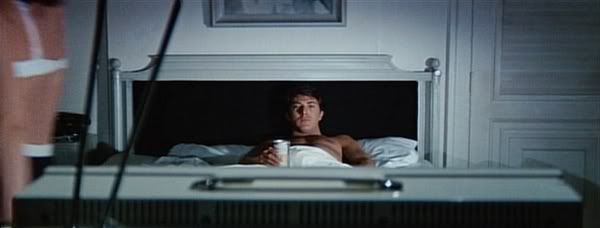
the graduate has a character reaching this same point of absolute alienation a few years later than harold and holden did; the narrative thus deals with situations that are a little more adult than the other films (although I guess it's true that harold dates a woman MUCH older than mrs. robinson). but this film is harold and maude, it's donnie darko, it's catcher in the rye. the way I can tell this is that the gaze is exactly the same in all three films: I mean, this is basically this is basically this. (harold and maude and the graduate actually have a lot of shots that recall each other; maybe because they were both shot in california?)
and guess what - all these stories are centered around male protagonists! which means that the catalyst is always a love interest, always a girl. (perhaps this is why holden doesn't quite complete that character arc - his love interest never pans out.) but what about the girl?
it's been, admittedly, years since I read the bell jar; I'm not sure why it's made less of an impression on me, maybe because it seems to lack the humor that the other stories have about themselves. I don't think we ever had to read it for school. I'm not quite sure what the female model of the coming-of-age story is; I don't have enough personal examples. I think it might be something like amelie, which I would count in this group. it's also the only european work I've considered here.
so there is this type of coming-of-age story that is american and male, and I'm sure I'm not the first person to have noticed that. I think it's interesting that these stories always remain very pro-individual; the character arc is never joining with society, realizing one's adulthood by finding a useful role in it. it's always "finding oneself" and society be damned. what happens to these characters right after their story ends - donnie's dead, harold is wandering around playing a banjo having just destroyed a car, and the famous example of benjamin and his stolen bride sitting there awkwardly in the back of the bus with more than a hint of anxiety in their faces - is probably not nearly as triumphant as what came before. I think it would be quite an achievement if we had a) stories that centered around females and b) stories that weren't so defiantly pro-individual throughout, but showed the character learning how to appreciate other people.
having a contest in my head for which adolescent-angst story will best stand the test of time; I have a whole collection of these queued up in my brain as though I had lived them, as though they're my own memories and I lived multiple lives in these multiple stories. I will never hesitate to admit that I fucking love me some quality adolescent angst, and the term "coming-of-age story" makes me salivate.
so now, it's time for considerations and comparisons. I'm taking out of the running stories which didn't make me feel the angst; stories like this side of paradise, in which amory is so obviously playing at being confused that it doesn't hold as a tension device; and the brief wondrous life of oscar wao, where the angst feels kind of second-hand and indirect and, more often than not, comical.
I suppose you can't really start a discussion of this without first naming catcher in the rye; I don't really see how you can beat this book for sheer character, voice, and these stealthy nods to coming-of-age archetypes, like when holden can't cross the street because he's afraid he'll fall before he gets to the other side. there are a couple of funny things about catcher: one, the parents don't seem all that bad, they seem pretty normal. they show up hardly at all. I think this is what led to a lot of my peers in high school sort of hating this book for being "whiny" or something.
the other odd thing is that holden doesn't change much through the course of the book; there's not a whole lot of difference between the holden at the beginning of the story and the one who's supposedly telling it from an institution or whatever. the book ends with the defeated line, "don't ever tell anyone anything, you'll start missing everyone," which sort of indicates that maybe holden has recognized a little that he mistreated people and should've appreciated them, but it's not much as far as character change goes.
harold and maude goes in the opposite direction (or as opposite as you can go for stories that feel like they take place in the same universe), and you see a very deliberate "character arc" being carved out: basically, harold learns to appreciate being alive. (seriously, boil this film down to its basic components and it seems scoff-worthy.) the harold who in the beginning feigns his own death a dozen different ways (and seems to possess no natural, human facial expressions) is very different from the character who's blowing bubbles in maude's bed.
the other 180-degree turn it takes from catcher is the total mockery of the parental and societal figures in the world; harold's mom and uncle are so ridiculous this movie almost verges into camp. I sort of resent the maker of the film for making it so easy to hate everyone around harold except maude, and yet it works because in many parts it is incredibly funny. the other reason it works, of course, is because it's balanced out with maude's very genuine carpe-diem spirit and love for the world; there's plenty of genuine feeling in this film. that moment where they flash to maude's holocaust-camp tattoo and then, barely showing it for a second, to maude pointing out how beautiful the sky is, may or may not strike you as cloying, but it's likely that you're so far on harold's side that you'll go along with it.
all of these characters have therapists. in fact, donnie darko might be harold and maude if you replace the carpe-diem message with deux-ex-machina. they both have disturbing visions; they see therapists for this reason. in these scenes, the therapist is not an entirely evil character. donnie's therapist even becomes a borderline appealing character, although she clearly is not cool enough to laugh or go along with it when donnie, under hypnosis, puts his hand down his pants. harold's therapist seems stupid but well-meaning. in both cases, and this is a key thing, I think, with these coming-of-age stories, the patient does not entirely resist the idea of being helped, of opening up, with the irrepressible hope that maybe, despite how uncool and idiotic these suit-and-tie characters are, they might offer some kind of wisdom.
which reminds me of every scene ever written by david foster wallace with a therapist in it. I sort of think that parts of infinite jest could be considered a coming-of-age novel on their own; certainly, hal was what I focused on the first time I read the book. the scene in the beginning, where hal's dad is pretending to be a therapist, simply reeks of the exact same pathos that permeates the aforementioned films. the therapist is almost a confidant, yet never manages to quite shed the external signs that s/he is part of the whole stupid mess that made this young person feel alienated in the first place. of course, when DFW tackles this emotional paradox he adds another layer of consciousness that you can't quite get in a film, where a character would freak out for about a page about using such a pretentious term as "alienated."
the graduate has a character reaching this same point of absolute alienation a few years later than harold and holden did; the narrative thus deals with situations that are a little more adult than the other films (although I guess it's true that harold dates a woman MUCH older than mrs. robinson). but this film is harold and maude, it's donnie darko, it's catcher in the rye. the way I can tell this is that the gaze is exactly the same in all three films: I mean, this is basically this is basically this. (harold and maude and the graduate actually have a lot of shots that recall each other; maybe because they were both shot in california?)
and guess what - all these stories are centered around male protagonists! which means that the catalyst is always a love interest, always a girl. (perhaps this is why holden doesn't quite complete that character arc - his love interest never pans out.) but what about the girl?
it's been, admittedly, years since I read the bell jar; I'm not sure why it's made less of an impression on me, maybe because it seems to lack the humor that the other stories have about themselves. I don't think we ever had to read it for school. I'm not quite sure what the female model of the coming-of-age story is; I don't have enough personal examples. I think it might be something like amelie, which I would count in this group. it's also the only european work I've considered here.
so there is this type of coming-of-age story that is american and male, and I'm sure I'm not the first person to have noticed that. I think it's interesting that these stories always remain very pro-individual; the character arc is never joining with society, realizing one's adulthood by finding a useful role in it. it's always "finding oneself" and society be damned. what happens to these characters right after their story ends - donnie's dead, harold is wandering around playing a banjo having just destroyed a car, and the famous example of benjamin and his stolen bride sitting there awkwardly in the back of the bus with more than a hint of anxiety in their faces - is probably not nearly as triumphant as what came before. I think it would be quite an achievement if we had a) stories that centered around females and b) stories that weren't so defiantly pro-individual throughout, but showed the character learning how to appreciate other people.
Sunday, April 19, 2009
MASTER PLOT #233: YOU DRINK TREE MILK AND A PLANT SHOOTS OUT OF YOUR CHEST
really good: Jungfrukällan (Virgin Spring) by Ingmar Bergman
really puzzlingly shitty: The Fountain by Darren Aronofsky
so, I was in ye olde corporate bookstore the other day and checking out one of those "master plots" books - actually, it was called 20 Master Plots. I have been passing these books by with a scoff for years, but on this occasion I was willing to humor the whole idea for a bit. I actually ended up reading about it after I'd gotten home, in summary form, on some forum page I found through google, which turned out to be part of this ayn rand worship website, which was a hilarious way to read about it. apparently, a lot of these plots support objectivist ways of living.
I discovered that the guy writing the book was not coming from a standpoint of "write a story like this and it will make you money," although obviously he profited from the book. but after poking around in it, it was clear to me why a book like this should exist: it should exist so that shit movies like The Fountain do not get made.
okay, but let's look at the good example first. Virgin Spring, which came out in 1960 but looks like it was made in the middle ages, was based on a 13th century Swedish ballad. it can be seen as a pretty conventional "revenge story" (which is one of the chapters in "20 master plots"), as its central plot revolves around a young girl getting raped and killed, and the family's subsequent reactions. the screenwriter, ulla isaakson, added some innovations that make it quite a bit more complex. there's a "dark" sister, who's already been raped (great parallelisms there), who sees her sister die and thinks it was her fault for praying to a pagan rather than a christian god (really interesting questions raised about religion in this film as well, especially since bergman doesn't try to make either side seem better). then there's a little boy who lives with the thieves who rape the girl, who watches all the shit go down and doesn't interfere. these two characters alone make for enough conflict and drama for an entire film, because of their shifting positions between good and evil. is the little boy an accomplice, or is he innocent? can you really blame the "dark" sister for wanting her good sister to fall into bad hands, after she herself was raped?
and somehow, even though the virgin character is completely one-sided and we know nothing good will come of her in the forest, her death is completely horrifying. I'm not quite sure how bergman managed to do that. it probably has to do with the quality of the acting, but it's also because, I think, this event is placed strategically in the plot, where it should be, after our expectations are already set up and we've seen the family dynamic and we definitely don't want her to die. the character gradually comes to represent everything that's good and desirable in the world. for me, this moment came when she was going up the hill on the horse and sang in a very clear, melodic voice and the shot was just of the countryside and it looks like the fucking garden of eden.
the horror over her death leads wordlessly to the classic question, why do bad things happen? which is taken up in a stirring sequence with max von sydow near the end.
then take The Fountain. both of these films are trying pretty openly to engage with a mode of storytelling that is highly mythic, but only one of them, I think, truly knows why or how to do this. Virgin Spring achieved this kind of mythic quality first of all by being set in the pretty distant past, rather than in a setting where we'd be able to judge whether this story was likely to happen or not. The Fountain is set in three times, and basically the only plot complexity it has comes from interweaving the threads. if you laid it out, the plot for this one would be extremely simple: the Quest Plot. and which quest? only the most obvious one, the Search for Immortality. some dude named Tommy is trying to find the cure for his wife's cancer (this was the plotline that most audiences, I think, latched onto).
I'll say right here that I loved Pi, and even admire Requiem for a Dream, though I'd rather eat a cactus than go through the wrenching experience of watching it again. but these interviews with Aronofsky about The Fountain are just astoundingly dumb. this quote comes from here:
I mean, all of it is like this, with this like ninth-grade-level philosophical background. what is with my favorite directors trying to make films about death and falling on their faces into philosophical schlock? really, the thing that makes us human is our mortality? where did you hear that, oprah's book club?
but honestly, I think a lot of artists would fail with these kinds of gargantuan ideas. there's a reason that myths take years upon years to develop; they don't just spring up when you sit down with a pen. in this film, aronofsky's got the germ of the myth, the quest for immortality, but he's got nothing else. he seems to think that just using that idea itself is going to make a good story - that, and about a dozen plot elements that every story falls back on when it can't give us something original. e.g., the guy's wedding ring gets lost early on. this is so cliche it makes me want to smack myself, but on top of this, throughout the rest of the film the character is constantly staring intensely (that's one of the three things this character does, along with sob and push things off of flat surfaces) at his finger w/absence of ring. also, there's a story within a story because the woman character is writing a book (NEVER HAVE I SEEN THIS BEFORE IN ANY MOVIE WOW). in longhand, with a fountain pen, of course.
aronofsky has no idea how to set up a story so that we care, so the only time I really felt like I might actually give a shit was two-thirds into the story. after that it promptly descended into kooky adolescent sequences involving meditating inside bubbles that shoot into outer space.
adding insult to injury, there's this maddening attitude that if you don't like this movie, you "didn't get it." aronofsky has actually made obnoxious comments about how, to watch it, you need to "suspend your disbelief" or else you, like, fail as a viewer. also, he says this film is like a rubik's cube - either you can sit there and puzzle it out, or you can throw it against the wall in frustration. both of which are incredibly condescending ways to treat your reader/viewer. who the fuck compares their art to a rubik's cube, except arrogant teenagers? convince me I should be suspending my disbelief, and I will.
my point is that you can't just achieve the level of myth that Virgin Spring had by reaching out and grabbing these mythic elements. I mean, it makes little to no sense to associate all the women with the tree/life imagery and motifs (which is done all the time in legends) if you aren't going to have her in some kind of setting where she actually gives life. (even worse if she happens to be the embodiment of death.) it only shows that aronofsky pretty much ignored most of the nuance of older legends, and just took the symbols and archetypes he thought were "deep," while adding absolutely nothing to them.
this is the sad thing about american film, for me - it seems to have no awareness of what has come before it, in terms of story. with the bergman film, you get the strong sense that he's in touch with the most basic legends of the human race, has thought about them, and is honoring them by redoing them in his own way. with aronofsky, it was just some kind of misled, self-aggrandizing thing that totally ignores all the other stories that have been created with the same ideas, thinking it's the first to try all this.
really puzzlingly shitty: The Fountain by Darren Aronofsky
so, I was in ye olde corporate bookstore the other day and checking out one of those "master plots" books - actually, it was called 20 Master Plots. I have been passing these books by with a scoff for years, but on this occasion I was willing to humor the whole idea for a bit. I actually ended up reading about it after I'd gotten home, in summary form, on some forum page I found through google, which turned out to be part of this ayn rand worship website, which was a hilarious way to read about it. apparently, a lot of these plots support objectivist ways of living.
I discovered that the guy writing the book was not coming from a standpoint of "write a story like this and it will make you money," although obviously he profited from the book. but after poking around in it, it was clear to me why a book like this should exist: it should exist so that shit movies like The Fountain do not get made.
okay, but let's look at the good example first. Virgin Spring, which came out in 1960 but looks like it was made in the middle ages, was based on a 13th century Swedish ballad. it can be seen as a pretty conventional "revenge story" (which is one of the chapters in "20 master plots"), as its central plot revolves around a young girl getting raped and killed, and the family's subsequent reactions. the screenwriter, ulla isaakson, added some innovations that make it quite a bit more complex. there's a "dark" sister, who's already been raped (great parallelisms there), who sees her sister die and thinks it was her fault for praying to a pagan rather than a christian god (really interesting questions raised about religion in this film as well, especially since bergman doesn't try to make either side seem better). then there's a little boy who lives with the thieves who rape the girl, who watches all the shit go down and doesn't interfere. these two characters alone make for enough conflict and drama for an entire film, because of their shifting positions between good and evil. is the little boy an accomplice, or is he innocent? can you really blame the "dark" sister for wanting her good sister to fall into bad hands, after she herself was raped?
and somehow, even though the virgin character is completely one-sided and we know nothing good will come of her in the forest, her death is completely horrifying. I'm not quite sure how bergman managed to do that. it probably has to do with the quality of the acting, but it's also because, I think, this event is placed strategically in the plot, where it should be, after our expectations are already set up and we've seen the family dynamic and we definitely don't want her to die. the character gradually comes to represent everything that's good and desirable in the world. for me, this moment came when she was going up the hill on the horse and sang in a very clear, melodic voice and the shot was just of the countryside and it looks like the fucking garden of eden.
the horror over her death leads wordlessly to the classic question, why do bad things happen? which is taken up in a stirring sequence with max von sydow near the end.
then take The Fountain. both of these films are trying pretty openly to engage with a mode of storytelling that is highly mythic, but only one of them, I think, truly knows why or how to do this. Virgin Spring achieved this kind of mythic quality first of all by being set in the pretty distant past, rather than in a setting where we'd be able to judge whether this story was likely to happen or not. The Fountain is set in three times, and basically the only plot complexity it has comes from interweaving the threads. if you laid it out, the plot for this one would be extremely simple: the Quest Plot. and which quest? only the most obvious one, the Search for Immortality. some dude named Tommy is trying to find the cure for his wife's cancer (this was the plotline that most audiences, I think, latched onto).
I'll say right here that I loved Pi, and even admire Requiem for a Dream, though I'd rather eat a cactus than go through the wrenching experience of watching it again. but these interviews with Aronofsky about The Fountain are just astoundingly dumb. this quote comes from here:
In some ways, we saw science as being like a religion, and how you can become dogmatic with it, and you can forget its relationship to the larger world. And for me, that’s reflected in a critique of how in the West, with the power of modern science, we’ve become detached from a major part of our spiritual existence. Because the reality is, no matter how much we fight death and put it in the corner and make believe it doesn’t exist, we all die. And the thing that makes us human is our mortality. But I think we’ve become disconnected from our mortality by hiding the fact that it’s part of our spiritual journey. In that way, science has its blinders on for trying to create immortality. There is nothing wrong with extending life. It’s incredible that you can be 75 and active and alive. But I had a 95-year-old grandmother who they tried to resuscitate three times, breaking her ribs. And there is something wrong with that. It’s a hard line to know where to draw. But there’s this fighting to keep people alive, even people who don’t want to be alive anymore.
I mean, all of it is like this, with this like ninth-grade-level philosophical background. what is with my favorite directors trying to make films about death and falling on their faces into philosophical schlock? really, the thing that makes us human is our mortality? where did you hear that, oprah's book club?
but honestly, I think a lot of artists would fail with these kinds of gargantuan ideas. there's a reason that myths take years upon years to develop; they don't just spring up when you sit down with a pen. in this film, aronofsky's got the germ of the myth, the quest for immortality, but he's got nothing else. he seems to think that just using that idea itself is going to make a good story - that, and about a dozen plot elements that every story falls back on when it can't give us something original. e.g., the guy's wedding ring gets lost early on. this is so cliche it makes me want to smack myself, but on top of this, throughout the rest of the film the character is constantly staring intensely (that's one of the three things this character does, along with sob and push things off of flat surfaces) at his finger w/absence of ring. also, there's a story within a story because the woman character is writing a book (NEVER HAVE I SEEN THIS BEFORE IN ANY MOVIE WOW). in longhand, with a fountain pen, of course.
aronofsky has no idea how to set up a story so that we care, so the only time I really felt like I might actually give a shit was two-thirds into the story. after that it promptly descended into kooky adolescent sequences involving meditating inside bubbles that shoot into outer space.
adding insult to injury, there's this maddening attitude that if you don't like this movie, you "didn't get it." aronofsky has actually made obnoxious comments about how, to watch it, you need to "suspend your disbelief" or else you, like, fail as a viewer. also, he says this film is like a rubik's cube - either you can sit there and puzzle it out, or you can throw it against the wall in frustration. both of which are incredibly condescending ways to treat your reader/viewer. who the fuck compares their art to a rubik's cube, except arrogant teenagers? convince me I should be suspending my disbelief, and I will.
my point is that you can't just achieve the level of myth that Virgin Spring had by reaching out and grabbing these mythic elements. I mean, it makes little to no sense to associate all the women with the tree/life imagery and motifs (which is done all the time in legends) if you aren't going to have her in some kind of setting where she actually gives life. (even worse if she happens to be the embodiment of death.) it only shows that aronofsky pretty much ignored most of the nuance of older legends, and just took the symbols and archetypes he thought were "deep," while adding absolutely nothing to them.
this is the sad thing about american film, for me - it seems to have no awareness of what has come before it, in terms of story. with the bergman film, you get the strong sense that he's in touch with the most basic legends of the human race, has thought about them, and is honoring them by redoing them in his own way. with aronofsky, it was just some kind of misled, self-aggrandizing thing that totally ignores all the other stories that have been created with the same ideas, thinking it's the first to try all this.
Sunday, January 18, 2009
MYKONOS
if you have to shiver and flail through the kind of winter they have here, you can at least make it momentarily magical by listening to fleet foxes, as their music always feels snow-coated. I have a bit of a crush on the singer-dude, although he probably has the typical unbearable big-lead-singer-head.
saw synecdoche, new york a second time; sadly, it did not hold up to another viewing. no one could analyze it without concluding that "he should have worked on it longer."
Saturday, January 3, 2009
ART IMITATING ART
 I finally saw synecdoche, new york. this is not a film you can absorb wholly during its runtime - it takes just that long for you to get all the ideas, and then they begin to rearrange themselves in your head for hours after you've left the theater. based purely on premise - man grows old and loses everyone, cannot finish his one creative work, and gets closer and closer to death - this might be one of the most depressing movies I have ever seen. I didn't feel altogether depressed while watching it, but I didn't feel too happy, after the first third of the movie. this one is not like kaufman's others; its metaphors are not neat, they don't "click" in the way the metaphor of getting into someone else's brain (malkovich) or erasing your memory (eternal sunshine) do. this caused me some confusion. I was sitting there waiting for the click which didn't come. instead, bizarre things happened - for one, the aging of caden's character was very odd and disorienting. caden is constantly misinterpreting how much time has elapsed - at one point, a character says it's been a year since his wife left, and caden counters that it's been a month. the viewer has no idea who's right. at another point, caden insists the daughter he's lost is four, and the other character says she's over eleven. the plotline with the daughter doesn't get anymore coherent, either. I thought it was one of the weirdest aspects of the film.
I kept watching this confusing stuff and wondering, "what the fuck?" so many things would just happen that were brutal - not in a gory way, but in an emotional way - and the characters would just keep going. it took me way too long to figure out that this story is based more on dreams than an actual story of a character who is supposed to represent someone in real life. the script at times felt like it was written by someone on drugs, particularly when caden started spouting abstract notions about what theater is. I thought, maybe I am just not artsy enough to appreciate this movie. obviously I could tell that having a real estate agent selling a woman a house that's constantly on fire is not realism. but I didn't get quite how the particular dream-logic of this film worked.
which is why I will need to see it again. I appreciate that it uses the psyche of one character to control events - for example, caden will see himself in every TV show and every advertisement - but I'm just not sure whether this was the point, or what the point was.
it's like, if kaufman were doing his usual thing, he'd set up a "real" universe where caden's life is unraveling in a comic way, and then a "simulacrum" art-universe, and the difference between the two would be clear enough that, at the key moment when art and life are conflated, the audience would get it and feel that "click" (kind of like when you realize that adaptation has been taken over by donald kaufman and becomes all about car chases and guns). but this film probably isn't only about art imitating life, because "life" as we know it in that equation is not present in this film. so it's kind of about art imitating art.
since I feel like the film I just described (art imitating life) has been done many times before - it feels old - I am glad kaufman didn't do this. and though, as the person I saw it with said, synecdoche breaks so many of the rules of storytelling, I love kaufman so much that I wanted to give him the benefit of any doubt. I would much rather a film fail like this than succeed in a typical way (e.g. the dark knight, which I watched recently and thought was somewhat boring and at no point transcended its genre). the character we see in this film might not be a hero, and he arguably doesn't even change through the story; but I know that kaufman knows what the rules are, and was deliberately breaking them.
(I feel confident in this conclusion because I've watched like every single interview with charlie kaufman about this film.)
Tuesday, November 18, 2008
LAMELY PAWING TOWARD CULTURAL ANALYSIS
I ought to be working, but I am going to blog about angelina jolie. if you live in a country like ours long enough you can easily tell that being a celebrity takes a healthy amount of ego and self-interest; it almost goes beyond that, into a kind of imperialism of personality. these people - oprah winfrey, george clooney, whatever, joe the plumber - clearly have a different sense of self than the rest of us. this is obvious, I am not "exposing" anything here.
angelina jolie seems to have this kind of perspective embedded in every cell of her body. I have never seen anyone so intensely self-interested; it is as though she is wholly composed of the hollywood myth. I don't mean this in the way that her life follows some kind of hollywood narrative arc; I mean she clearly believes her actions belong to some sphere of behavior that is super-human, or worthy of watching. people who believe they deserve to be watched interest me, because I am always thinking "why am I drawing attention to myself like that, I am so lame".
I never see or hear anything about angelina jolie that makes me think "hey, that's sort of similar to my life." I don't see any human vulnerability in her, even her phase when she was "acting out" by doing weird things like carrying billy bob's blood around and talking about sex with women seemed totally out of a movie universe. she is her own movie. I have never seen a human being like this before.
sometimes I try to figure out why I, like the rest of the world, can't help but pay attention to her, at least once in a while. I think for me it has to do with her version of femininity (I feel like I put too many letter 'i's in that word). she seems to have totally bypassed the cute, romantic-comedy girl and gone onto something far more aggressive and swaggering. I think that is a good word for what she does in movies like tomb raider (which I think I might have seen ten minutes of on a plane once) - she swaggers. I like this about her. I hate the version of women that you see on shows like gilmore girls - I mean I pretty much hate everything about that show, but especially that the women seemed stuck in this kind of trivial universe and only the men were allowed to be kind of mysterious and romantic.
the articles that are written about angelina jolie - I read one in esquire a while ago that was absolutely ridiculous - tend to be so overblown and full of pomp and ballast, analyzing her, in the way I am tempted to, as a mythical figure instead of a person. they know, they can sense that she is not like other people in that she is her movies. trying to decide whether she's being "fake" in the above video is totally beside the point; there is no "real" version of her. I think she has been totally overcome by the personality empire that she's built, which I partly admire and partly abhor. it seems to define american culture in some basic way, that our need to influence has more to do with personality than with money. we use money to throw our influence as wide and far as we can, because fame gives the illusion of happiness, and best of all, of something happening.
I've been reading this fantastic book by lydia davis lately and this might be my favorite opening ever in fiction:
We have all these favorite shows coming on every evening. They say it will be exciting and it always is.
we are angelina jolie's totally captive audience.
Tuesday, October 21, 2008
HOW TO HAVE A GRAD SCHOOL CONVERSATION
broach the topic by connecting something - your lunch, Tuesday, the weather - to deconstructionism. bring up foucault and derrida in the same sentence. say "there is no center". compare the setting you are immersed in to a simulacrum, and say "baudrillard was more right than he knew" with a tragic note in your voice. repeat every two days or so.
......................
I had forgotten what psychic overload cities are. was anyone meant to live in them? I don't understand. in the train station I was so exhausted from just being around people that I rudely turned down someone's request to use my phone - I just thought about what a mental investment it was to make a connection to another human being, lend them the phone, wonder if they're going to rack up some kind of charge on it, get it back, think about whether this person's hands were clean when using the buttons, etc etc etc. this is sad.
art museums are also another kind of overload, but they get ideas moving, although many are useless. I am still of the opinion that though there is an infinity of art that could be made, some of it shouldn't. still on the fence about these two-color block prints by abstract painters from the fifties. is this a rejection of the complexity of modernity? I found myself fixating on the explanatory notes beside the paintings - giving you a key concept to latch onto, for example, when confronted with a big canvas full of splotches you look helplessly at the plate and read "religion" and go AH, and only then do you begin to interpret.
if it doesn't speak to you, it doesn't speak to you.
......................
listen to this interview with charlie kaufman from wired magazine - it's unedited, and in between charlie's halting sentences about the nature of art and commercialism in film and mortality you can hear him ask the waiter for more ketchup.
......................
I had forgotten what psychic overload cities are. was anyone meant to live in them? I don't understand. in the train station I was so exhausted from just being around people that I rudely turned down someone's request to use my phone - I just thought about what a mental investment it was to make a connection to another human being, lend them the phone, wonder if they're going to rack up some kind of charge on it, get it back, think about whether this person's hands were clean when using the buttons, etc etc etc. this is sad.
art museums are also another kind of overload, but they get ideas moving, although many are useless. I am still of the opinion that though there is an infinity of art that could be made, some of it shouldn't. still on the fence about these two-color block prints by abstract painters from the fifties. is this a rejection of the complexity of modernity? I found myself fixating on the explanatory notes beside the paintings - giving you a key concept to latch onto, for example, when confronted with a big canvas full of splotches you look helplessly at the plate and read "religion" and go AH, and only then do you begin to interpret.
if it doesn't speak to you, it doesn't speak to you.
......................
listen to this interview with charlie kaufman from wired magazine - it's unedited, and in between charlie's halting sentences about the nature of art and commercialism in film and mortality you can hear him ask the waiter for more ketchup.
Monday, October 6, 2008
Tuesday, August 19, 2008
movies I want to see, like, right now
it's still technically summer, for a week, so I can get away with such a frivolous post...
synecdoche, new york - I have been waiting like a patient disciple for the newest work by my patron saint, charlie kaufman. it seems like forever since I read the leaked screenplay for this...and was pretty confused, I have to say. I have no idea how this film is going to work. what I read of the screenplay was about a main character who had lots of lovers and health problems (I remember something about green feces), all in crisis at once. it didn't seem to match the description of the movie, which is supposedly about a man who constructs a version of manhattan for a play that is as big as manhattan itself (or something) - look up 'synecdoche' if you don't remember anything from AP english. I want to see this so bad, philip seymour hoffman is starring, and kaufman is directing. you can see a couple little clips of it here.
lou reed's berlin - forget shine a light, give me a documentary on berlin anyday. berlin was one of those albums that, when I was sixteen, perfectly matched my developing conception of what adult life was really like. it's not a happy album, but songs like "men of good fortune" and the "caroline says" series seemingly had no melody, which laid the focus on their fantastic, if bleakly existential, lyrics. I couldn't get over lines like "it's so cold in alaska" paired with depictions of domestic violence - that was totally poetic to me. I marveled at how reed could get away without really singing. I'm still somewhat indifferent toward the velvet underground, but reed's solo work was a huge deal to me in high school. there's a weird kind of determination that emanates from songs like "how do you think it feels" and "sad song". don't even get me started on "the bed".
brief interviews with hideous men - I have been waiting for-fucking-ever for john krasinski to release this film version of a david foster wallace book (!!!!). I'm having doubts that it will ever come out, but I continue to monitor it. this is a complicated book and I'm interested to see how it gets made - if krasinski uses voiceovers, I will kill him.
the curious case of benjamin button - an adaptation of probably the strangest f. scott fitzgerald story I've ever read. this sounded like a horrible idea, except that david fincher is directing.
w. - uh, obviously. actually the trailer is good enough. I think josh brolin is going to be fantastic, and I get the feeling oliver stone's not going to just slap together the same old rise-to-fame biopic, but also not going to do an obvious parody but something more nuanced.
synecdoche, new york - I have been waiting like a patient disciple for the newest work by my patron saint, charlie kaufman. it seems like forever since I read the leaked screenplay for this...and was pretty confused, I have to say. I have no idea how this film is going to work. what I read of the screenplay was about a main character who had lots of lovers and health problems (I remember something about green feces), all in crisis at once. it didn't seem to match the description of the movie, which is supposedly about a man who constructs a version of manhattan for a play that is as big as manhattan itself (or something) - look up 'synecdoche' if you don't remember anything from AP english. I want to see this so bad, philip seymour hoffman is starring, and kaufman is directing. you can see a couple little clips of it here.
lou reed's berlin - forget shine a light, give me a documentary on berlin anyday. berlin was one of those albums that, when I was sixteen, perfectly matched my developing conception of what adult life was really like. it's not a happy album, but songs like "men of good fortune" and the "caroline says" series seemingly had no melody, which laid the focus on their fantastic, if bleakly existential, lyrics. I couldn't get over lines like "it's so cold in alaska" paired with depictions of domestic violence - that was totally poetic to me. I marveled at how reed could get away without really singing. I'm still somewhat indifferent toward the velvet underground, but reed's solo work was a huge deal to me in high school. there's a weird kind of determination that emanates from songs like "how do you think it feels" and "sad song". don't even get me started on "the bed".
brief interviews with hideous men - I have been waiting for-fucking-ever for john krasinski to release this film version of a david foster wallace book (!!!!). I'm having doubts that it will ever come out, but I continue to monitor it. this is a complicated book and I'm interested to see how it gets made - if krasinski uses voiceovers, I will kill him.
the curious case of benjamin button - an adaptation of probably the strangest f. scott fitzgerald story I've ever read. this sounded like a horrible idea, except that david fincher is directing.
w. - uh, obviously. actually the trailer is good enough. I think josh brolin is going to be fantastic, and I get the feeling oliver stone's not going to just slap together the same old rise-to-fame biopic, but also not going to do an obvious parody but something more nuanced.
Thursday, August 14, 2008
I watched roger & me, which came out when I was still a kid, and was so moved, until I read that a lot of it, including the fact that moore never got to meet with the CEO of GM, is rearranged to moore's liking (must be satisfying kicking aspiring documentarians out of your functions after it's been done to you by roger smith!). this supposedly from an oscar-winning maker of "documentaries" who went up on stage and called bush's war a "fiction."
then, later, I watched an episode of the west wing about capital punishment which was supposedly "fiction" but left me feeling far more enlightened on the issue, which is dealt with through the perspective of a leader who must choose whether or not to let another human die, than I did after watching moore's film.
I guess this means pure fiction is more powerful than corrupt nonfiction. either that or aaron sorkin is just smarter than michael moore.
then, later, I watched an episode of the west wing about capital punishment which was supposedly "fiction" but left me feeling far more enlightened on the issue, which is dealt with through the perspective of a leader who must choose whether or not to let another human die, than I did after watching moore's film.
I guess this means pure fiction is more powerful than corrupt nonfiction. either that or aaron sorkin is just smarter than michael moore.
Thursday, April 24, 2008
mixed drivel
this about sums up my feeling today - how can she make the argument that she's "more electable" based on a DEMOCRATIC PRIMARY where the two choices are both democrats?? just because she got the majority of older white women in pennsylvania does not mean they won't vote for obama in the general. BAH, I wash my hands of this media nonsense.
I basically knew nothing of daniel day-lewis before seeing there will be blood; I bring this up only because I watched an interview with him and was completely baffled and surprised. I can barely make the connection between the guy in the interview and daniel plainview. they are hardly the same person. if I were on the set of twbb and daniel plainview started speaking in that day-lewis, british, choirboy tenor voice I would be so confused. I don't know where the hell he came up with his accent for this film (I don't think of 1900-era americans as pronouncing the word call like "cole"), but goddamn if he didn't completely transform himself for this role. highly impressive.
I turned in my key today. in exactly a week, I'll be without a job. I'm anticipating sitting in fields and thinking a lot, trying to detox myself of all the built-in sense of routine I've been living the last year or so. you'll find me anyplace that has no schedule.
I basically knew nothing of daniel day-lewis before seeing there will be blood; I bring this up only because I watched an interview with him and was completely baffled and surprised. I can barely make the connection between the guy in the interview and daniel plainview. they are hardly the same person. if I were on the set of twbb and daniel plainview started speaking in that day-lewis, british, choirboy tenor voice I would be so confused. I don't know where the hell he came up with his accent for this film (I don't think of 1900-era americans as pronouncing the word call like "cole"), but goddamn if he didn't completely transform himself for this role. highly impressive.
I turned in my key today. in exactly a week, I'll be without a job. I'm anticipating sitting in fields and thinking a lot, trying to detox myself of all the built-in sense of routine I've been living the last year or so. you'll find me anyplace that has no schedule.
Sunday, March 9, 2008
march

I'm in one of those time-warp phases where it seems I have no time for anything, at work I think of all the things I want to read or see or do, and then when I actually have free time I don't want to do anything except listen to beck and play snood.
I did watch magnolia yesterday, because I thought about it after seeing twbb; I remembered that I liked it, but not much else. I was shocked at how bad this movie is - it's not so bad for the average hollywood director, but for PTA, it blows, especially when compared with twbb. it seems that PTA just couldn't be bothered to figure out what magnolia is supposed to be about, what it's supposed to say. is it about the innocence of children? the eerie power of coincidence? about fucking up and forgiving? about the falseness of television? the only thing that might unify this whole pastiche would be something unbelievably bland, like the theme of "making mistakes" or something. though john c. reilly and philip seymour hoffman had appealing characters, the rest - julianne moore, ugh - were totally unlikeable. the gameshow kid with eerie blue eyes, who sits in the library and says "this is something that happens" when the frogs fall from the sky, is a goofy, corny conceit.
it's too bad, because PTA is someone I consider kind of a "voice" for a generation, in that I feel like a lot of his concerns are ones I would come up with, if I were a filmmaker. we are on the same wavelength as far as feelings toward modern society go - especially in punch-drunk love, which uses a loophole in a pudding coupon as its catalyst - and he is definitely a director who tries to nail certain ideas. sometimes this goes over awkwardly, as I felt it was when tom cruise nearly burst a vein in his forehead while telling his dying father he was a fucking asshole. sometimes it goes over with incredible grace, as it did when plainview is "blessed" by the boy-preacher in one of the best scenes of twbb. either way, PTA is trying to portray a certain idea of an emotion - forgiveness, hate, or revenge. sometimes this means the work gets too cerebral and abstract, which I really felt magnolia was. I think most of the connections in magnolia were there in PTA's head, but didn't make it into the film. which is really, really too bad, because the stylistic control and technique in all of his films, not just this one, are superb. for example, the whole first half of the film is scored with buildup music, which seems to be creating some interesting tension - but then it never really goes anywhere, and just ends up being annoying.
in many ways magnolia seemed like a hysterical realist novel, with many extraneous symbols and sundry subject matter smashed into one incoherent messy plot - except that this one never cohered, at any point, really. even the point we were supposed to go "ohh, I see", where they all sing along to the aimee mann song (which, don't get me wrong, was a cute and original idea), didn't make the rest of the movie clear. the rain of frogs, another plot twist you might read in a DFW novel, seemed too weird for no certain purpose. which, I'll just repeat again, is really too bad, because if they had found a good purpose, those techniques and elements would have been truly striking.
Sunday, January 27, 2008
blood

what an underwhelming movie. I mean, what was the story about? the music wasn't evocative enough. I thought daniel day-lewis wasn't crazy enough. and I was like, where's all the blood?
just kidding.
this movie was fucking INSANE. holy CRAP it was good. I don't even know what to say about it. the amazing thing was how it plunged you into the mind of a psychotic businessman; it wasn't some flimsy biopic that is like, "look at this crazy man, isn't he sad?" I mean it really forced you to look at the world the way he would. the freaky-ass music by jonny greenwood kind of helped in this.
and daniel day-lewis was unbelievable. kind of makes javier bardem in no country look like one of the gilmore girls. ok maybe not really, I should leave no country out of this.
after I watched it I was so distracted I almost drove off the road. I had really intense dreams last night and this morning the first thing I said when I woke up was, "damn, that was good."
Sunday, January 20, 2008
politics

I watched an orson welles film last weekend, the stranger, about an ex-nazi who tries to hide in a naive community and comes to a pretty goofy (I thought) end. orson was one crazy bugger. I think what he did with "war of the worlds" would be crazy enough to qualify, but a few months ago I saw citizen kane on the big screen, and thought it was absolutely nuts. this was part of a double feature whose other half was the maltese falcon. an extremely enjoyable evening. the crackling of the screen, the organ man with his levitating pedestal, and the booming of kane's voice as he stood in front of his adoring public, infinitely hopeful, a fool of a man, horribly admirable.
the other day my boss decided that we should ignore work for forty minutes while he talked about politics, and fuck if it wasn't interesting. he covered afghanistan, the kennedy assassination, malcolm x, foreign dictators we've supported, iran contra, and of course the '08 campaign. I told him I wasn't voting for hillary just because she's a woman, because that's sexist, and he just stared at me so long that I wondered if what I'd said had actually made sense.
also another time I was teasing him about eating meat all the time and he started talking about how he eats meat because he's addicted, like smoking, and that humans have evolved so far that we don't even need to eat meat, we could just be vegetarians and still be completely healthy. so that time it was my turn to just stare and blink.
"exactly," I said then. "that's exactly what I think."
the idea of hillary becoming president kind of depresses me. that's probably an overreaction, but I'm still on the obama bandwagon. hillary's experience is not more appealing than obama's intelligence and obvious idealism.
Sunday, December 2, 2007
finally got around to seeing no country for old men last night. although I don't think it is, as some people have been raving, the best movie of the last decade, it was quietly mesmerizing. I can't stop thinking about it. josh brolin and javier bardem were fantastic, the scenery was perfectly desolate. I wonder if the book had so many instances of men following thin trails of blood, or if that's just a coen brothers artistic touch. but most of all, I appreciated the stately, dignified pace of the film. I loved that a deliberate action by one of the men - carefully placing the briefcase in an air duct - would be accompanied by equally deliberate cinematography - at one point, a character knocks a lamp to the floor and it lies perfectly upside down between the two beds, where moments later it illuminates the underside of the beds for another character. I thought there was a little too much philosophizin' toward the end, especially considering that the catalyst of the entire film was anton chigurh, a man whose actions seem to have little meaning. however, when anton himself did philosophize, it was always interesting. the fact that bardem's spanish accent sounded so odd in this setting did a lot to establish this character as somehow otherworldly, from a different universe.
also, anyone else remember carla jean moss as the schoolgirl who fucked ewan mcgregor in trainspotting? I couldn't even recognize her.
also, anyone else remember carla jean moss as the schoolgirl who fucked ewan mcgregor in trainspotting? I couldn't even recognize her.
Sunday, October 14, 2007
i'l let you be in my dream if I can be in yours, I said that
it didn't occur to me until I started watching don't look back that I hadn't heard dylan talk before. that lazy, steely, low-pitched whine is so distinctive. the way he leads reporters around in circles was something I anticipated, having read a few. if you ask bob dylan a question, be prepared to have him ask one back. and take note of that exchange with a fan (I don't know who he is?) in the practice room, before a show; dylan sways and rocks with his guitar and throws back all the kid's questions. the picture couldn't be more iconic: some skinny guy with long fingernails and a frizzy head of hair talking to a kid with those fifties glasses and combed back hair. the artist versus the "square", the defining difference here being one's insistent questions against the other's even more insistent, vague answers. some of us go through life constantly trying to pin down ideas and file them away, but people like bob dylan would have none of that. not just regarding ambiguous ideas, either - at one point the kid says he's a science student, and dylan goes, "what does that mean? what does that say about you?" no matter what he says, the kid can't really answer dylan's questions.
other questions dylan will answer flippantly, with a slouching good humor - questions like "what is your religion" will bring yet more questions, and the end result will be that dylan happily mumbles that no one's ever given him worthwhile to believe in, so he's not religious. nor does he really have a "message". but this extreme nihilism is, I kept thinking, deceptive. watch him at the parts when he's grilling a reporter for some major magazine like "time", telling him that no one in the magazines ever tell a story straight, that if they did it would be an interesting collage of life and not just "facts", and that he could sit there and explain why he's not a folk singer, but the reporter would just nod and not really get it. added to these outbursts, there's the obvious hint that his songs have to "mean" something, even if dylan will insist that he believes in nothing. otherwise they'd be completely boring, which they obviously aren't.
this movie is about bohemian culture overtaking the towns in london that we see dylan touring. at the end of the movie some newspapers are giving dylan a new label - "anarchist" - which he chuckles at, amazed. it's possible that he is/was, but I would never accept that he is a nihilist.
* * *
yesterday you could have seen me dance in the streets after al gore & the ipcc won the nobel peace prize. it's all symbolic, I know, and gore still probably won't run, but I was happy that he was recognized.
today I picked up the colbert book but got the most chuckles out of this book, which tells you how to fight global warming in your own home/community. scan the table of contents - one chapter of this well-intentioned book is called, "Make it Creative (And Fun!)"
hot damn! I can't wait!
other questions dylan will answer flippantly, with a slouching good humor - questions like "what is your religion" will bring yet more questions, and the end result will be that dylan happily mumbles that no one's ever given him worthwhile to believe in, so he's not religious. nor does he really have a "message". but this extreme nihilism is, I kept thinking, deceptive. watch him at the parts when he's grilling a reporter for some major magazine like "time", telling him that no one in the magazines ever tell a story straight, that if they did it would be an interesting collage of life and not just "facts", and that he could sit there and explain why he's not a folk singer, but the reporter would just nod and not really get it. added to these outbursts, there's the obvious hint that his songs have to "mean" something, even if dylan will insist that he believes in nothing. otherwise they'd be completely boring, which they obviously aren't.
this movie is about bohemian culture overtaking the towns in london that we see dylan touring. at the end of the movie some newspapers are giving dylan a new label - "anarchist" - which he chuckles at, amazed. it's possible that he is/was, but I would never accept that he is a nihilist.
* * *
yesterday you could have seen me dance in the streets after al gore & the ipcc won the nobel peace prize. it's all symbolic, I know, and gore still probably won't run, but I was happy that he was recognized.
today I picked up the colbert book but got the most chuckles out of this book, which tells you how to fight global warming in your own home/community. scan the table of contents - one chapter of this well-intentioned book is called, "Make it Creative (And Fun!)"
hot damn! I can't wait!
Sunday, August 26, 2007
I just ordered this. I'm very excited. kerouac's original writing got edited, like any other writing, when it was published; but if there's ever a book that was meant to be published unedited, it's on the road. read the original review (.pdf file) of the book in the NY Times; it seems pretty spot-on for something written in 1957. I don't know, my idea of 1957 is pretty dim: men with military haircuts who adhere to cardboard ideas of "moral modernity." I don't know.
you know, I love miranda july. I drooled over MAYAEWK. which was why I was a little shocked and confused that I didn't love No One Belongs Here More Than You. it felt cheap and commercial in places; which was the last thing I expected. but stories like "The Swimming Lesson" made me angry. they were like five pages of "quirky characters," very self-conscious "conceits" in place of story. I felt cheated by the easy shortcuts she took in some of the stories, like "Majesty," which was just a string of these quirks being played out almost in ordered alternation. it started to feel unspontaneous, very polished, and, you know what, commercial.
that's not to degrade the very high quality of stories like "Something That Needs Nothing," which truly does venture into deep waters. I really like that image of the main character wandering across town in a t-shirt that's cut off halfway and reads HONK. "Some people honked without even seeing the shirt." I liked that line. "How to Tell Stories to Children" is another great one.
but let me talk about why the movie was so great, and worked better: she had characters in ordinary situations saying weird things. those were the moments that made me feel the most enthralled, when two people just standing in a department store would suddenly say, "I loved you more than I have ever loved anyone," or something, I can't remember the exact line. but the progression was both striking and totally acceptable, in the world she had created.
this doesn't happen so successfully in the book, because everything is just snapshots. those kind of moments have to be earned, I feel, over a long period of time. if I were miranda july I would have extended one of the really good stories that I mentioned before into a novel, where there would be more elements to play around with, instead of just like three, which is not very many. it's kind of like an amateur magician who expects the audience to be surprised by switching three cards a few times and then goes, "where's your card? there - isn't it amazing!" and it's like, dude, I don't get distracted that easily - I saw that one coming.
you know, I love miranda july. I drooled over MAYAEWK. which was why I was a little shocked and confused that I didn't love No One Belongs Here More Than You. it felt cheap and commercial in places; which was the last thing I expected. but stories like "The Swimming Lesson" made me angry. they were like five pages of "quirky characters," very self-conscious "conceits" in place of story. I felt cheated by the easy shortcuts she took in some of the stories, like "Majesty," which was just a string of these quirks being played out almost in ordered alternation. it started to feel unspontaneous, very polished, and, you know what, commercial.
that's not to degrade the very high quality of stories like "Something That Needs Nothing," which truly does venture into deep waters. I really like that image of the main character wandering across town in a t-shirt that's cut off halfway and reads HONK. "Some people honked without even seeing the shirt." I liked that line. "How to Tell Stories to Children" is another great one.
but let me talk about why the movie was so great, and worked better: she had characters in ordinary situations saying weird things. those were the moments that made me feel the most enthralled, when two people just standing in a department store would suddenly say, "I loved you more than I have ever loved anyone," or something, I can't remember the exact line. but the progression was both striking and totally acceptable, in the world she had created.
this doesn't happen so successfully in the book, because everything is just snapshots. those kind of moments have to be earned, I feel, over a long period of time. if I were miranda july I would have extended one of the really good stories that I mentioned before into a novel, where there would be more elements to play around with, instead of just like three, which is not very many. it's kind of like an amateur magician who expects the audience to be surprised by switching three cards a few times and then goes, "where's your card? there - isn't it amazing!" and it's like, dude, I don't get distracted that easily - I saw that one coming.