
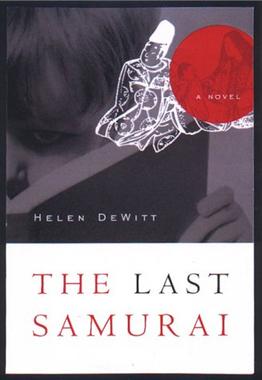
 I want to write about the book the last samurai. it has NOTHING to do with the ridiculous tom cruise movie. I read it while I was in new york, after hearing of it on the DFW mailing list. this book is astoundingly good. I want to start an underground society of people who like this book. there are so many things in it - Greek, Japanese, theories of mathematics, thermodynamics, painters, musicians, chess, London subways, and of course, seven samurai.
there is no way to describe this book; you have to read it to experience its unusual syntax and form of expression. it's basically a novel of ideas. the story is about a woman who, in raising a son, faces questions of why we educate our children the way we do and also why we need fathers. or on the flipside the story is about a young boy named Ludo who is incredibly precocious and who spends the length of the book looking for a suitable father, after meeting his real father and finding him unworthy. but really, this book is about everything else. you might begin this book wondering why it goes on so many tangents. in the end, you will realize that it is its own coherent world. which is, in my mind, when a book succeeds.
I think helen dewitt has only written this one novel, I'm not sure. she's not someone I hear of regularly. in 2004 she lived on staten island and attempted suicide. I think she lives in berlin now. her blog is here; she is probably a lot like the sibylla character in the last samurai (someone wrote a review of the book that said, "I loved this book, although sibylla was obviously a thinly veiled version of dewitt herself" and I thought oh, so you must know her pretty well then?). in this novel she manages to capture many of the feelings I share about education - mostly feelings of frustration. this is one of my favorite passages:
"Say you grow up in the type of place that is excited to be getting its first motel, moving from town to town as one motel is finished and another begun. You are naturally not enthralled by school and achieve a solid B- average. Presently you take Scholastic Aptitude Tests and astound everyone by a degree of scholastic aptitude which places the B- average in an entirely different light. Your teachers take the result as a personal insult. You apply to various colleges, who ask for references, and teachers who have reduced you to speechless torpor write complaining of apathy. You are interviewed on the basis on dazzling scholastic aptitude and you are asked about your interests and you have no interests. You have no extracurricular activities because the extracurricular activity was the Donny Osmond Fan Club. Everyone turns down your application on the grounds of apathy."
I'm not saying that's representative of my situation, or anything. but the appearance of apathy part I understand. also I was always annoyed by how much they played up extracurricular activities - as though if you weren't president of some meaningless club it must mean you sat in your room and stared at the wall all day.
dewitt also imbues the story with another theme I find really fascinating and haven't really seen in most novels I've read - maybe in ironic works like dave eggers' AHWOSG - about the difference between good art and bad art. in the story, sibylla puts a lot of terrible paintings (the way she described them makes me think of thomas kinkade) and books in front of her son and says, you cannot meet your father until you realize why these are bad. a lot of the dualities in the book are between good art and bad art, real intelligence versus false intelligence. there is a part with two students, one of whom takes everything he studies to heart so much that he fails all his classes, and another who would not be interested in learning anything if he didn't have anyone to compete against.
but if it were just a lot of chatter about books and knowledge, I wouldn't have anything to rave about. the fact is that helen dewitt combined a winning story with some absolutely great postmodern elements - incorporating films and historical events into the story-world - to make what I find to be an absolute chef d'oeuvre. it has inspired me to learn more, not to impress other people, but just for the sake of living more fully.
one really odd thing about this book is how similar it is to jonathan safran foer's extremely loud & incredibly close; I have no idea whether JSF read this book or not, but it came out before his. both are about a precocious boy looking for his father, in a quest-style plot, and they both use disparate elements in a postmodern way. I would say JSF focused more on being inventive with text; dewitt was slightly more focused on content. and even though it's been years since I've read EL&IC, I have to say that the last samurai is better, with much more subtance. the juvenile quality of the narrative is understated, and not exploited to cloying effect. tragedies are not arbitrarily brought into the plot (I know, EL&IC is not supposed to be a "September 11" novel, but I was always a little uneasy about how JSF used that event in his story). there isn't so much of a focus on having "dazzling" writing. that's how I feel after reading both of them, one at a point in my life when dazzling writing was very important to me, one at another time when I am beginning to see the value in doing a lot of extensive research, to make the book as rich as possible.
go here to buy the last samurai, read it, and join my society of people who love this book.


2 comments:
I remember that comment about 'thinly disguised' etc etc. I think books are often autobiographical in ways people don't talk about. Every character in the book is the author. The 'self' (whatever that means) is not a unity, it is made up of conflicting impulses, some socially sanctioned, some stigmatised, all competing for space in the life span of a single body. In a book one can give a whole life to every one of these impulses - the mad linguist, the philosopher, the promiscuous gameplayer, the alienated artist, the ruthless scientist (the number of possible lives one walks away from is endless, the number of possible lives ruled out without one's consent is endless). That is why characters are often so much more compelling than real human beings (including the author).
One thing I thought one could do in a book was make visible some of the choices that had been made on the reader's behalf. Most readers will not have been offered Greek and Japanese at school. If a reader sees Greek on the page and thinks: Oh, I could do that! I could have done that when I was 6! it's clear that the reader does not really know, has no way of knowing, what he or she might have been. The reader has been formed by contingencies, by the fact that the people who offer primary education don't normally think that a child might like Greek (or Japanese, or Hebrew, or Arabic...), that some children might like more mathematics than is normally offered. If an (auto)biography is reduced to the list of things that happened to happen, the choices that were made from a restricted menu, that tells us next to nothing about the person described. Everybody understands that there is a difference between, say, the Home edition of Microsoft Office and the Professional version, between Photoshop and Photoshop Elements, between the free Acrobat Reader and the expensive version of Acrobat that enables you to create your own PDFs, create forms and so on. The gap between what is normally offered in schools and, say, what J S Mill and Yo Yo Ma got from their fathers is comparable (thought incomparably greater), but invisible. So much so that most readers don't think: I might have been like Ludo if I had had Photoshop instead of Elements, they think: this is a story about a genius. Which is exactly what's interesting.
wow, definitely was not expecting the novelist herself to reply to this post...makes me a bit self-conscious about my unabashed fawning over the book. of course I agree with the autobiographical aspect - how could a character *not* be its author? I was just talking about this with someone else, how people tend to oversimplify and want to know which biographical details match the characters...but then I realized I am guilty of this. as soon as I read a book I am insanely curious about the author.
the point about choices made for you is also very interesting because it makes me think of the whole passage at the beginning of last samurai, with the betting and odds and everything, in a new light, kind of links them together. so when I read the book again I will see if those concepts connect - they seemed a little disparate the first time I read it, although I absolutely loved the first section about the father going to seminary school. that definitely ties into having choices in education.
it's interesting also that when I work with young kids that are ludo's age, I am constantly surprised to discover how truly intelligent they are...their reasoning abilities are definitely intact, as early as five years old, and it's mostly the lack of worldly knowledge (generalizing here) that holds them back. if you give them knowledge about something they wouldn't normally know about, they can come up with some really interesting and original ideas. so, ludo was not so unbelievable to me (only in certain rare parts).
Post a Comment